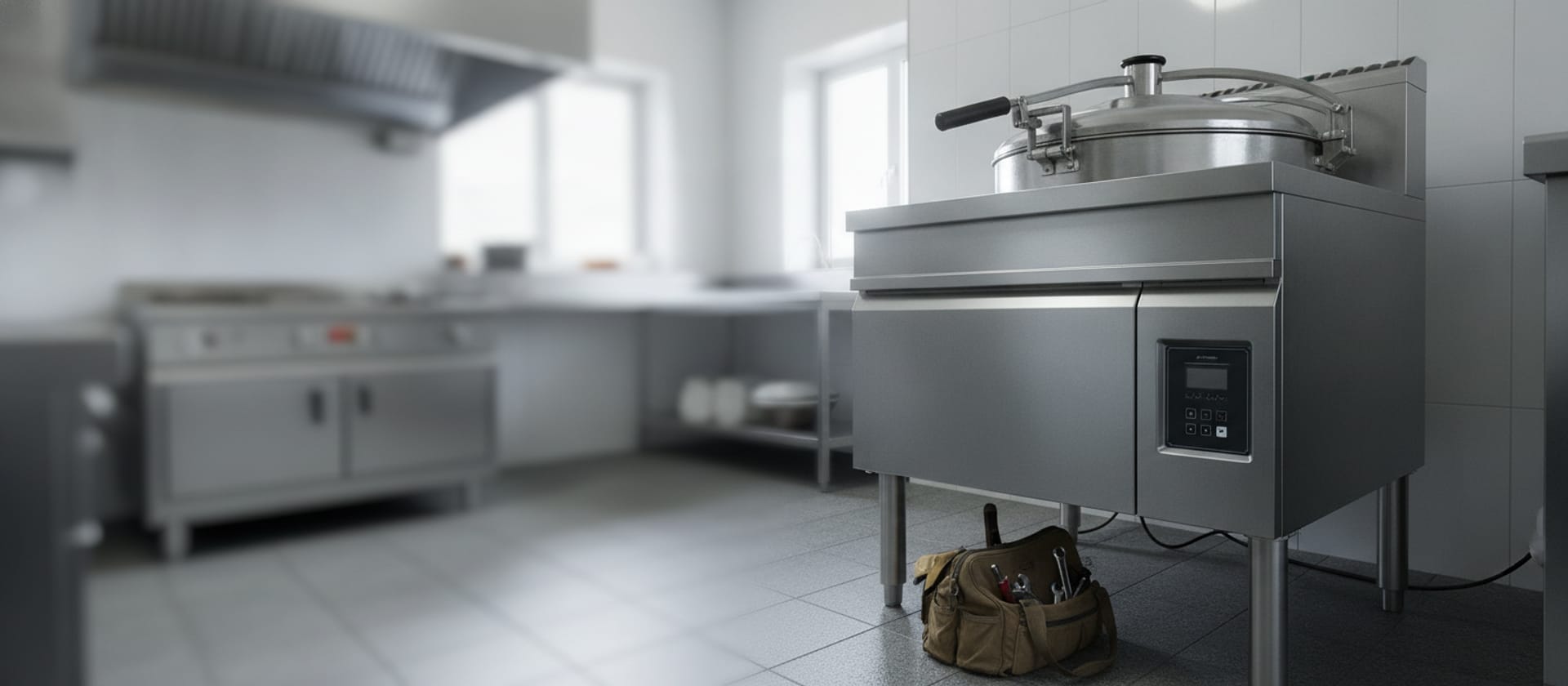

Henny Penny Fryer Repair
Henny Penny Commercial Fryer Repair
Henny Penny 500 / 561 / 600 / 1000 pressure fryer + PFE/PFG open-fry repair across Southern California. $120 diagnostic waived with repair. (424) 325-0520.
AI Diagnostic · free · about a minute
Fryer acting up?
Describe it in your own words — get the likely causes and a repair cost range before you book.
Our Branches
10 service territories across Southern California
Where we work
Local branches across Southern California
Ten branches covering Los Angeles, Orange, Ventura, Santa Barbara, San Bernardino, and Riverside counties. Same-day visits when a technician is available.
Los Angeles
Brentwood, Bel Air, Pacific Palisades, Santa Monica, Westwood, Century City, Culver City, Westside, Long Beach
Henny Penny at a glance, Eaton Ohio 1957, employee-owned, pressure-fryer pioneer
A Henny Penny pressure fryer that loses pressure, won't seal, or trips its safety interlock usually traces to one of three patterns our techs at Same Day Appliance Repair diagnose first across LA's KFC, Popeyes, and Chick-fil-A franchise locations running 500, 561, 600, and 1000 series pressure fryers, plus independent fried-chicken and hot-chicken kitchens. (1) Door gasket and pressure-chamber seal wear, the gasket loses seal so the chamber can't hold cook-cycle pressure, affecting cook quality and eventually safe operation; door gasket $200 to $380, pressure chamber seal service $450 to $750. (2) PSI relief valve and lid interlock, the safety-critical components, the relief valve is inspected every 90 days and replaced on the manufacturer cadence, and the lid interlock that blocks opening under pressure must function before the fryer returns to service; PSI valve service $180 to $320, replacement $280 to $480, lid interlock $250 to $420. (3) Thermocouple, burner ignitor, or gas regulator on gas models, oil-temperature instability or ignition faults; thermocouple $180 to $320, ignitor $220 to $380. $120 commercial diagnostic, waived with repair. Pressure-fryer safety service is trained-tech scope, not DIY.
Henny Penny was founded in Eaton, Ohio in 1957, not in Eaton, California (that's a different place), and not affiliated with Eaton Corporation (the industrial products company; different entity entirely). Henny Penny has operated continuously for nearly seventy years from the same Eaton Ohio headquarters, manufacturing commercial pressure fryers, open-fry commercial fryers, and a broader range of commercial kitchen equipment.
The brand is genuinely independent, employee-owned through an ESOP (Employee Stock Ownership Plan) structure since the late 1990s. This is worth emphasizing because the commercial fryer market is otherwise dominated by three major consolidators: Ali Group (which owns Frymaster since the July 2022 Welbilt acquisition), Middleby Corporation (which owns Pitco via the Blodgett 1981 acquisition chain), and ITW (which owns Vulcan). Henny Penny sits outside that consolidation entirely, it's NOT Ali Group, NOT Welbilt, NOT Middleby, NOT ITW, and not any other major commercial foodservice conglomerate. The independence shapes the company's engineering roadmap, parts network, and service training program, all of which remain distinct from the consolidator families.
The company's founding fact is the commercial pressure fryer itself. Henny Penny was founded specifically to commercialize the pressure-fryer concept that emerged from its founders' partnership with Colonel Harland Sanders during the early development of Kentucky Fried Chicken's cooking process. The pressure-fryer mechanism, sealing a conventional fryer under controlled pressure to dramatically reduce cook time while retaining moisture, became the industry-defining technology for fried-chicken QSR operations, and Henny Penny has remained the OEM pressure-fryer spec across the major fried-chicken chains ever since. Pressure fryer engineering is the technical domain where Henny Penny's engineering moat lives; the company also makes open-fry commercial fryers, but pressure is the signature product category.
Henny Penny fryer lineup, pressure and open-fry
500 / 561 series, mid-capacity pressure
Mid-range pressure fryers sized for smaller franchise locations, secondary fryers in multi-unit configurations, and lower-volume independent operations. 500 and 561 variants are common across LA KFC secondary-location installs and Popeyes mid-volume operations.
600 / 1000 series, high-capacity pressure
Higher-capacity pressure fryers for high-volume QSR franchise primary fryers, high-traffic restaurant operations, and situations where 500-series throughput wouldn't keep pace with service demand. The mainstay at high-volume LA KFC and Popeyes locations.
HC series, KFC OEM configuration
Specific configuration historically associated with KFC OEM spec across their franchise system. Engineering fundamentals are pressure-fryer standard but with KFC-specific controls and operational programming. Service follows the pressure-fryer safety-service protocol with KFC-specific maintenance documentation where applicable.
PFE-500 / PFG-500, open-fry
Standard open-fry commercial fryers, PFE electric, PFG gas, for operations that want Henny Penny engineering without the pressure-fryer architecture. Common in mixed-fryer kitchens (pressure plus open-fry) or at operations that prefer Henny Penny for brand consistency.
Velocity series, high-efficiency open-fry
Henny Penny's high-efficiency open-fry line with reduced energy consumption and CARB Title 20 compliance. Eligible for California Energy Commission rebate programs and Southern California Edison commercial-rebate programs. Common in operations specifically targeting utility-bill reduction at install or retrofit.
OFE / OFG 321 / 322, open-fry variants
Open-fry variants below the Velocity flagship tier. OFE for electric service, OFG for gas. Standard open-fry service path with Henny Penny parts supply. Less common in LA than the pressure-fryer volume but present in mixed-fryer commercial installations.
KFC, Popeyes, and Chick-fil-A, LA franchise cluster that runs on Henny Penny
The three major US pressure-fried-chicken QSR chains, KFC, Popeyes Louisiana Kitchen, and Chick-fil-A , all specify Henny Penny pressure fryers as OEM across their franchise systems. In LA County, that translates to real franchise density across all three chains: KFC's long-standing LA County presence, Popeyes' aggressive LA expansion during and after the 2019 chicken-sandwich wars, and Chick-fil-A's steady LA growth across all seven counties we service. Every one of those franchise locations runs Henny Penny pressure fryers.
Franchise service for these chains has specific operational context that differs from standard restaurant service:
- KFC franchise service, coordinates through franchise operators and KFC corporate maintenance programs. Our role is typically emergency response during service windows, out-of-scheduled-maintenance events, and documentation support for franchise maintenance records.
- Popeyes franchise service, similar corporate-franchise coordination structure. Post-2019 chicken-sandwich wars expansion pushed many franchises into tight service-window operational cadence; emergency response capacity matters more than ever.
- Chick-fil-A franchise service, highly centralized franchise operator-support model with specific maintenance protocols. Our scope typically aligns with out-of-warranty and out-of-authorized- provider-window events.
Our Henny Penny service approach at QSR franchises follows franchise-operator protocols without claiming chain-corporate authorization, we're independent service complementing the authorized Henny Penny provider network. Many franchise operators use both paths depending on urgency and scope. Beyond the franchise system, Henny Penny also appears at independent fried-chicken restaurants, LA's hot-chicken specialty operations, and specialty cuisine kitchens using pressure-fryer technology for non-chicken applications.
Pressure-fryer safety, PSI relief valve, door gasket, lid interlock
Across the Henny Penny service calls our techs at Same Day Appliance Repair dispatch in LA, the work clusters predictably, with the pressure-fryer safety components leading because they're inspected on every visit. About 25 percent door gasket and pressure-chamber seal service. 20 percent PSI relief valve inspection, service, and replacement. 15 percent lid interlock and door latch assembly. 15 percent thermocouple, oil-temperature probe, and burner ignitor. 10 percent gas regulator calibration on gas models. 10 percent filter pump and filter paper or O-ring. 5 percent main control board or full pressure-chamber service. The three safety-critical components below are inspected on every Henny Penny call.
Commercial pressure fryers are genuinely dangerous equipment when safety-critical components fail. The pressure chamber operates at significant positive pressure during cook cycles, and the safety architecture that prevents over-pressurization, unsafe door opening, and chamber failure is not optional equipment , it's what keeps a pressure fryer from becoming a safety incident. Honest framing on this page: pressure- fryer safety service is scope our techs handle, not something operators should attempt DIY.
The three safety-critical components we inspect and service on every Henny Penny pressure fryer call:
- PSI relief valve, the fail-safe that releases pressure if the primary pressure controls fail to maintain the safe operating range. Inspection every 90 days during routine service; manufacturer- recommended replacement cadence (typically annually for high-volume commercial use). Replacement and post-replacement pressure testing require specific training and the correct replacement parts; this is definitively not a DIY item.
- Door gasket and seal integrity, the pressure chamber door gasket creates the sealed pressure environment during cook cycles. Gasket degradation leads to pressure loss (cook quality affected) and eventually to unsafe operation if the seal compromises under pressure. Inspection every service visit; replacement on condition or manufacturer-recommended cadence.
- Lid interlock mechanism, the mechanical interlock that prevents the door from being opened while the chamber is under pressure. This is the last-line safety mechanism. Inspection and function verification on every service call. Failure of the interlock is a safety-critical condition that requires immediate repair before the fryer is returned to service.
The authorized-service path for Henny Penny pressure fryers routes through trained providers specifically because of these safety requirements. Our techs have pressure-fryer service training, carry the correct replacement parts, and perform post-service verification testing. We document the PSI relief valve inspection and service values, gasket condition, and lid interlock function in every Henny Penny work order.
Velocity series and California energy rebates, CARB Title 20, SCE, LADWP
The Henny Penny Velocity series is the brand's high-efficiency open-fry line, engineered with reduced energy consumption to meet CARB Title 20 compliance requirements and qualify for California Energy Commission commercial foodservice equipment rebate programs plus Southern California Edison and LADWP commercial-rebate programs where those programs have active funding.
For LA operators considering Velocity retrofit or new-install specification, the financial math usually favors Velocity once utility rebates plus lifecycle energy savings are factored in, especially for commercial operations running heavy fry volumes where the energy savings compound. The rebate amounts change, check cec.ca.gov and your specific utility commercial-rebate programs for current status, but the Velocity lineup qualifies where rebate programs are active. We can advise on Velocity-specific maintenance that preserves the ENERGY STAR performance characteristics during service calls, and we can help operators think through the retrofit economics if a Velocity upgrade is on the table.
Independent employee-owned, what it means for parts and service
Because Henny Penny is genuinely independent (not Ali Group, not Middleby, not ITW, not any other consolidator), its parts supply chain runs through its own distribution network rather than through the Ali Group NA parts infrastructure at Winston-Salem (which covers Frymaster, Champion, CMA, Manitowoc, Garland, Lincoln, and a dozen other Ali brands), the Middleby Corporation parts infrastructure (which covers Pitco, Ultrafryer, Anets, Blodgett, Southbend, Imperial, TurboChef), or the ITW Food Equipment Group parts infrastructure at Chicago (which covers Vulcan, Hobart, Traulsen, and the ITW FEG siblings).
In LA, Henny Penny parts flow primarily through Pacific Heating & Training Systems (PHT) and the direct Henny Penny distribution relationships. Common parts, door gaskets, PSI relief valve service kits, filter paper and O-rings, thermocouples, burner ignitor components, we stock on our trucks or pull from regional US inventory with 2–5 day typical lead time. Specialty parts for pressure-chamber components, main controller boards, and Velocity-series heat-exchanger components typically run 5–10 days from Eaton Ohio through the Henny Penny distribution channel.
The practical implication: Henny Penny service can't use the Ali Group, Middleby, or ITW multi-brand single-call approach that we apply to other fryer brands. A Henny Penny service call is brand-specific, we're not bundling a Frymaster fryer fix and a Champion dishwasher fix into the same Henny Penny visit because the parts accounts are separate. That's honest framing of what the independent-brand service reality is. For operations that run mixed-fryer installs (Henny Penny pressure plus Pitco open-fry plus Vulcan range), we can still service the combination but each brand pulls through its own parts channel.
What Henny Penny commercial fryer repair costs in LA
$120 flat commercial diagnostic, waived with repair. Typical Henny Penny service ranges:
| Repair | Typical range (parts + labor) |
|---|---|
| Thermocouple replacement | $180–$320 |
| PSI relief valve inspection and service | $180–$320 |
| Filter paper + O-ring kit (pressure + open-fry) | $180–$320 |
| Oil temperature probe | $200–$340 |
| Door gasket replacement (pressure chamber) | $200–$380 |
| Burner ignitor assembly (gas models) | $220–$380 |
| Gas regulator calibration | $220–$380 |
| Door latch assembly | $240–$420 |
| Lid interlock assembly | $250–$420 |
| PSI relief valve replacement | $280–$480 |
| Filter pump service | $380–$640 |
| Pressure chamber seal service | $450–$750 |
| Main control board | $700–$1,300 |
| Full pressure-chamber service | $800–$1,500 |
Most Henny Penny service calls land $380–$850 parts-and-labor. Pressure-chamber specific jobs and PSI valve replacement run at the higher end due to safety-verification requirements. Full cross-brand context in our commercial fryer repair cost guide.
Related Henny Penny and commercial fryer peer pages
Henny Penny pressure fryer repair, frequently asked
Is Henny Penny owned by Ali Group, Welbilt, or Middleby?
None of those. Henny Penny is genuinely independent, employee-owned (ESOP structure) since the late 1990s, headquartered in Eaton, Ohio, operating continuously since 1957. It is NOT Ali Group, NOT Welbilt, NOT Middleby, NOT ITW, and not part of any other major commercial foodservice consolidator. Common confusion online: because the commercial fryer market is dominated by Ali Group (Frymaster via Welbilt 2022 acquisition), Middleby (Pitco via Blodgett 1981 acquisition chain), and ITW (Vulcan), many service-provider and industry-content pages assume Henny Penny must belong to one of them. It doesn't. That independence matters operationally, Henny Penny maintains its own parts network, its own service training program, and its own engineering roadmap independent of the big consolidators. And Eaton, Ohio, not Eaton, California, and not Eaton Corporation (the industrial-products company); Henny Penny is a separate entity.
Did Henny Penny invent the pressure fryer?
Yes, that's the brand's founding fact. Henny Penny was founded in 1957 specifically to commercialize the pressure-fryer concept, which emerged from a partnership between the company's founders and Colonel Harland Sanders in the development of Kentucky Fried Chicken's cooking process. The pressure-fryer mechanism, sealing a conventional fryer under controlled pressure to cook chicken significantly faster while retaining moisture, became the industry standard for fried-chicken QSR operations, and Henny Penny has remained the OEM spec across KFC, Popeyes, and Chick-fil-A for decades. Pressure-fryer engineering is the distinguishing technical domain of the brand; Henny Penny also makes open-fry commercial fryers (the PFE, PFG, Velocity, and OFE/OFG lines), but pressure is where the brand's engineering moat lives.
Which QSR chicken chains use Henny Penny pressure fryers?
The three major US pressure-fried-chicken chains all run Henny Penny as their OEM pressure-fryer spec: KFC (since the Colonel Sanders partnership at the company's founding), Popeyes Louisiana Kitchen (long-standing spec), and Chick-fil-A (long-standing spec across their chicken-sandwich and original chicken products). In LA, that translates to substantial franchise density across all three chains, KFC's LA County presence, Popeyes' aggressive LA expansion during the 2019 chicken-sandwich wars and continuing, and Chick-fil-A's steady LA growth across all seven counties we cover. Every one of those franchise locations runs Henny Penny pressure fryers. Our service work at these locations typically covers out-of-scheduled-maintenance events, emergency response during service windows, and situations where the franchise operator's authorized-provider dispatch doesn't fit the operational clock.
How often should a Henny Penny pressure fryer's PSI relief valve be inspected and serviced?
The PSI relief valve is safety-critical and should be inspected every 90 days minimum during routine pressure-fryer service and replaced on the manufacturer-recommended service cadence (typically annually for high-volume commercial pressure fryers, though specific intervals vary by model and use profile). The relief valve prevents over-pressurization of the pressure chamber, it's the fail-safe that keeps a pressure fryer from becoming dangerous if the primary pressure controls fail. This is genuinely scope our techs handle, not something operators should attempt DIY. Pressure-fryer safety service requires specific training, the correct replacement parts, and proper post-service pressure testing to verify the valve is functioning within spec. We carry the PSI relief valve service on our standard Henny Penny service runs and document the inspection and service values in the work order.
What's the difference between Henny Penny 500 series and 600/1000 series pressure fryers?
Capacity and output tier. The 500 and 561 series are mid-range pressure fryers sized for mid-volume operations, smaller franchise locations, secondary fryers in multi-unit configurations, lower-volume independent operations. The 600 and 1000 series are higher-capacity for high-volume operations, major QSR franchise primary fryers, high-traffic restaurant operations, and situations where the 500-series throughput wouldn't keep pace with service demand. The HC series is a specific configuration historically associated with KFC OEM spec. For service, the mechanism fundamentals are similar across the capacity tiers, pressure chamber seal, PSI relief valve, lid interlock, door gasket, but parts are specific to each model series and the larger 600/1000-series units have heavier service cycles on the pressure-side components.
What about open-fry Henny Penny models, PFE, PFG, Velocity?
Henny Penny also makes open-fry commercial fryers (non-pressure) for operations that want Henny Penny engineering without the pressure-fryer architecture. PFE-500 (electric) and PFG-500 (gas) are the standard open-fry models. Velocity series is Henny Penny's high-efficiency open-fry line with reduced energy consumption and eligibility for California Energy Commission CARB Title 20 rebate programs plus Southern California Edison commercial-rebate programs. OFE-321/322 (electric) and OFG-321/322 (gas) complete the open-fry lineup. These aren't as distinctive in the commercial fryer market as Henny Penny's pressure work, Pitco and Frymaster dominate the open-fry volume, but operators who want Henny Penny open-fry typically specify it for brand consistency across a pressure-plus-open-fry kitchen configuration.
What does Henny Penny pressure fryer repair cost in LA?
$120 flat commercial diagnostic, waived when you authorize the repair. Typical Henny Penny service ranges: PSI relief valve inspection and service $180–$320, door gasket replacement $200–$380, lid interlock assembly $250–$420, thermocouple $180–$320, burner ignitor (gas models) $220–$380, gas regulator calibration $220–$380, oil temperature probe $200–$340, filter paper + O-ring kit $180–$320, door latch assembly $240–$420, PSI relief valve replacement $280–$480, filter pump service $380–$640, pressure chamber seal service $450–$750, main control board $700–$1,300, full pressure-chamber service $800–$1,500. Most Henny Penny service calls land $380–$850 parts-and-labor. Pressure-chamber specific jobs and PSI valve replacement run at the higher end due to safety-verification requirements. See our commercial fryer repair cost guide.
Why is my Henny Penny pressure fryer losing pressure?
On a Henny Penny pressure fryer, lost pressure during the cook cycle is almost always a door gasket or pressure-chamber seal problem. The chamber door gasket creates the sealed pressure environment; when it degrades it leaks, so the chamber can't reach or hold the cook-cycle pressure, cook quality drops, and left unaddressed the seal can compromise under pressure, which is a safety issue. Door gasket replacement runs $200 to $380; deeper pressure-chamber seal service is $450 to $750. We also verify the PSI relief valve and lid interlock on the same visit because pressure-fryer safety components are inspected every call. This is trained-tech scope, not a DIY repair. Same Day Appliance Repair diagnoses it on a $120 commercial diagnostic, waived with repair.
How often should a Henny Penny pressure fryer be serviced for safety?
On a Henny Penny pressure fryer, the safety-critical components are inspected on every service visit, and the PSI relief valve specifically should be inspected at least every 90 days and replaced on the manufacturer-recommended cadence (typically annually for high-volume commercial use). The relief valve is the fail-safe against over-pressurization; the door gasket maintains the sealed chamber; and the lid interlock prevents the door from opening while the chamber is under pressure. All three require trained-tech service with the correct parts and post-service pressure testing, not DIY. For a high-volume LA KFC, Popeyes, or Chick-fil-A location, a quarterly pressure-fryer safety service keeps the relief valve, gasket, and interlock within spec. We document the inspection and service values in every work order.
Henny Penny pressure fryer down? Call the branch nearest your kitchen.
Same-day across Los Angeles, Orange, Ventura, Santa Barbara, San Bernardino, Riverside, and San Diego counties. $120 commercial diagnostic, waived with repair. Pressure-fryer safety-service specialists.