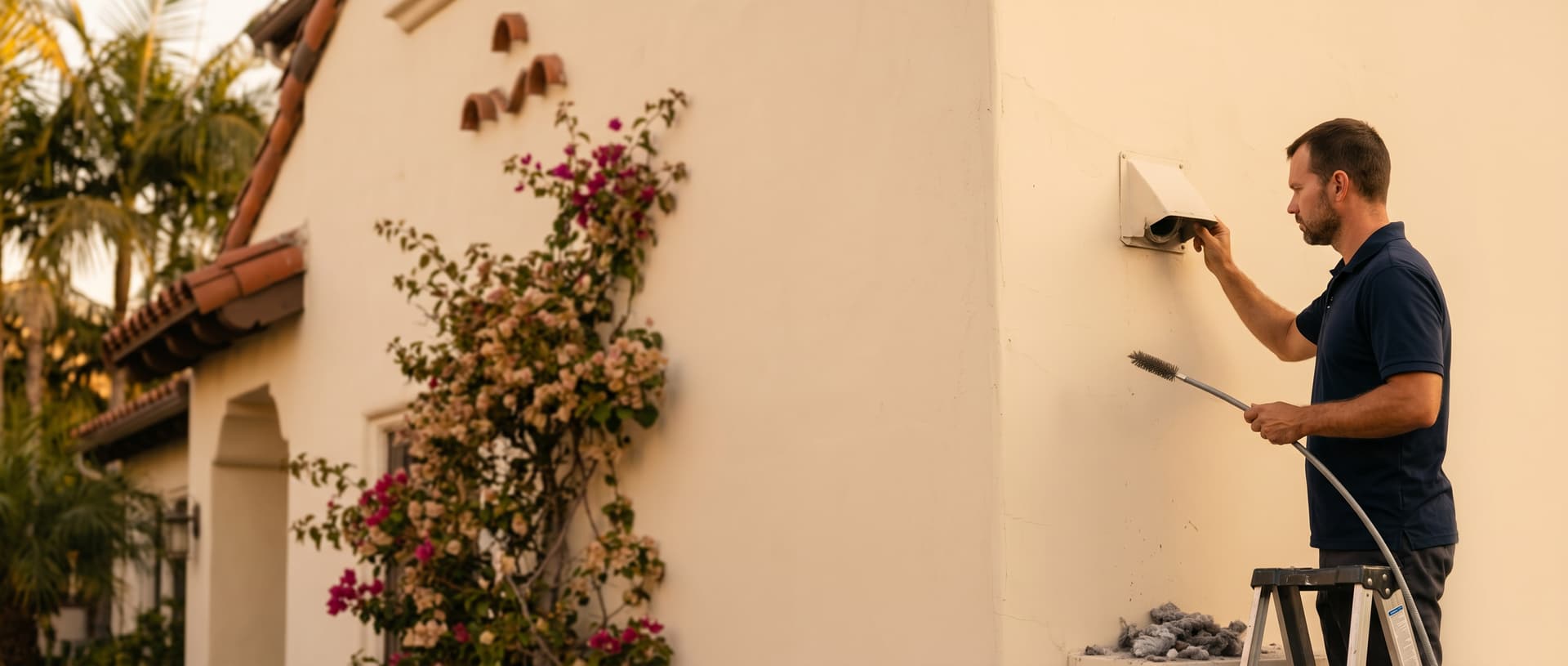
Residential Dryer Vent Repair · Transition Duct + Lint-Trap + Booster Fan · LA Home Repair · Same Day
Dryer Vent Repair Across Southern California
Transition duct, lint-trap housing, booster fan, exterior vent-flap, and the vent run to the exterior. Same-day across Los Angeles, Orange, Ventura, Santa Barbara, San Bernardino, Riverside & San Diego counties. $89 diagnostic.
AI Diagnostic · free · about a minute
Dryer acting up?
Describe it in your own words — get the likely causes and a repair cost range before you book.
Our Branches
10 service territories across Southern California
01, About This Service
Dryer vent repair, from the dryer collar to the exterior vent.
When a dryer vent needs repair across Southern California, our techs at Same Day Appliance Repair trace it to a handful of appliance-side patterns: a crushed or disconnected transition duct ($100–$240), a cracked lint-trap housing ($90–$230), and a failed in-line booster fan on long runs ($200–$450). We handle the appliance side, the short run from the dryer to the wall connection, the lint-trap housing, the vent collar and the exterior vent-flap, and the vent run through walls and roof caps as well. $89 residential diagnostic, applied toward repair. BHGS #A49573, EPA 608 Universal certified (#1346255700410).
Dryer venting sits between two jobs: the dryer itself (motor, heat source, drum, belt, thermal fuse, electronics) and the venting pathway from the dryer to the exterior of the home (transition ducts, in-wall and in-ceiling runs, booster fans on long installs, exterior vent terminations, roof caps). We handle both, so one visit covers the whole airflow path.
The most common vent work is appliance-side: the short run from the dryer cabinet to the wall connection, the lint-trap housing, the vent collar on the back of the dryer, the booster fan if one sits in-line, and the exterior vent-flap. That work overlaps directly with dryer service, the parts, the diagnostic approach, and the tools are the same ones we use on dryer calls.
Longer runs through walls and ceilings, roof-cap terminations and multi-story shared vent systems we handle too; we confirm access when you book. Fire-code compliance certification inspections are a separate certification service.
02, What We Handle
Appliance-side repair and the vent run behind it
We handle the repair portion that overlaps with dryer service and the vent run from the wall to the exterior. One call, one team.
✓ Appliance-side repair
- Transition duct replacement (4-inch short run from dryer to wall)
- Lint-trap housing replacement and cleaning
- Vent-collar repair at back of dryer (where the duct connects to the unit)
- Booster-fan replacement (in-duct supplemental fans on long runs)
- Exterior vent-flap or vent-door replacement
- Appliance-side restriction diagnostic (is the dryer's performance issue vent-caused?)
- Dryer-side disambiguation (is it actually a vent problem or a heating-element or thermal-fuse issue?)
✓ Vent run work
- Full home vent-system cleaning
- Long vent runs through walls, ceilings, and attic spaces
- Roof-cap vent terminations requiring roof or ladder access
- Multi-story apartment and condo building shared vent-system cleaning
- Commercial laundromat, multi-unit, and commercial-plant dryer venting
Separate from repair: fire-code compliance inspection and certification, and vent-path reconstruction or re-routing (general-contractor scope).
03, Common Symptoms
When appliance-side dryer vent repair is the answer
Not every "dryer not working right" call is a vent problem, and not every vent problem is an appliance-side vent problem. Our diagnostic establishes which is which before any repair order is written.
Extended Drying Times
The most common vent-related symptom. A partially restricted transition duct or a lint-buildup at the appliance side of the vent reduces airflow; the dryer runs longer cycles to reach dryness. Whether the restriction is appliance-side (transition duct, lint trap, vent collar) or further along the run through walls or ceilings, we clear it.
Dryer Running Hot
When vent airflow is restricted, heat accumulates in the dryer cabinet instead of venting outside. The back of the dryer feels unusually hot, cycles may end early on a safety trip, and in severe cases the thermal fuse or high-limit thermostat can trigger. We check appliance-side vent restriction and dryer-side heat controls together.
Visible Damage to Transition Duct
Crushed, torn, kinked, or disconnected transition duct between the dryer and the wall. This is the single most common appliance-side vent repair, the flexible transition duct gets crushed when the dryer is pushed back against the wall, or torn when the dryer is moved for cleaning behind it. Replacement runs in the $80–180 labor plus parts range.
Visible Lint at Back of Dryer
Lint escaping around the connection where the transition duct meets the dryer's vent collar indicates a poor seal, a cracked collar, or a disconnected duct. In the short term this means lint accumulation in the laundry-room space; over time it means reduced venting effectiveness and heat buildup. Appliance-side repair, our scope.
Exterior Heat or Reduced Airflow at Termination
The exterior vent-flap or vent-door may have failed in the closed or partially-closed position, restricting airflow out of the home. If it's accessible from ground level or a short step-stool, we replace it on the spot. If the termination is on a roof cap or second-story wall, we handle it too and confirm ladder or roof access when you book.
Booster Fan Failure
Homes with long vent runs sometimes have an in-duct booster fan installed to maintain airflow. When the booster fan fails, the vent effectively becomes an extended run with no assist, dry times extend significantly. Appliance-side booster fan replacement is our scope. Fan assembly replacement runs $120–250 labor plus $80–200 parts depending on specific unit.
Vent service guides
- Vent Cleaning Needed — six warning signs, DIY vs professional, annual baseline
- Fire Safety — NFPA stats, warning signs, insurance documentation
- Code Compliance — CA Building Code, HOA, multi-unit common vent
04, Fire-Safety Context
Why a damaged or restricted vent is worth fixing promptly
FEMA and NFPA report ~15,000–16,000 annual US dryer fires
Dryer fires are a recognized residential fire-safety category. FEMA and NFPA data show approximately 15,000–16,000 dryer fires annually in US homes, with lint buildup identified as a leading ignition factor and restricted airflow a contributing accelerant. The NFPA addresses dryer and exhaust-system fire hazards in its standards for clothes dryer installation and use (NFPA Section 28 on clothes dryer fire hazards). Local fire-department advisory language across Southern California counties (LAFD, OCFA, Ventura County Fire, San Bernardino County Fire, Riverside County Fire) echoes the general NFPA guidance on vent-system maintenance frequency.
The appliance-side portion of the vent system, the piece between the dryer and the wall connection, is a concentrated location for lint to accumulate because it's the first restriction point in the airflow path. A crushed transition duct, a torn lint-trap housing, or a damaged vent collar concentrates lint exactly where heat accumulates. Keeping this portion of the system mechanically intact is one of the more meaningful fire-risk reductions available at appliance-repair scope.
The full home-vent-system side of fire-risk management, the long run through walls and to exterior termination, we handle as well, on a maintenance cadence that fits the run length. Apartment-building and multi-unit fire-code compliance typically requires specialist inspection and documented certification, which is outside residential appliance-repair scope.
05, Which Service You Actually Need
Component repair or vent-run cleaning, how to tell
Two different problems, both ours. A damaged or failed component needs a replacement; lint accumulation in a long vent run needs cleaning. When it could be either, our $89 diagnostic establishes which.
Appliance-side repair problem
A specific component has failed or is damaged, and the fix is a component replacement rather than a cleaning pass.
- Transition duct is visibly crushed, torn, or disconnected
- Lint-trap housing is cracked or damaged
- Booster fan has stopped working
- Exterior vent-flap is stuck or broken (accessible from ground level)
- Diagnostic call needed, is this a dryer problem or vent problem?
- Dryer cycle times suddenly longer + you want the appliance-side portion checked
- Fire-risk review of appliance-side vent after inherited or purchased home
Home-vent-system cleaning job
The problem is lint accumulation in the long run of the vent system rather than one failed component.
- Vent run is long (20+ feet) and has not been cleaned in years
- Routine annual or biennial preventive vent cleaning
- Roof-cap termination needs cleaning or replacement
- Multi-story apartment building shared-vent system
- Second-story or roof-access exterior termination work
- Commercial laundromat, multi-unit, or commercial-plant venting
Not sure which you need? The $89 residential diagnostic covers that question. We tell you honestly whether it's a component repair or a vent-run cleaning job, and we handle either.
06, Dryer Brand Cross-Reference
Dryer brands we service most with vent-adjacent work
Most appliance-side vent calls come alongside actual dryer-service calls on the common residential dryer brands. If you're calling about a vent issue, there's a good chance we'll look at the dryer itself during the same visit.
07, Pricing
Appliance-side vent repair pricing
$89 residential diagnostic, applied to the repair if you authorize. Typical appliance-side vent work runs $150–450 total depending on what's actually replaced.
Every repair includes a 90-day warranty on parts and labor. If the same issue returns within that window, we come back at no charge, in writing before we leave. Cross-reference: Dryer vent repair cost detail.
08, Frequently Asked Questions
Dryer vent repair, what people ask us
What's the difference between dryer vent repair and dryer vent cleaning?
Repair means replacing damaged or failed vent components, a crushed transition duct, a torn lint-trap housing, a failed booster fan, a broken exterior vent flap. Cleaning means removing lint accumulation from the vent pathway. These are distinct services. We handle both: the appliance-side repair (components within a few feet of the dryer), where the parts and diagnostic overlap with dryer service, and the vent run from the dryer to the exterior termination. The diagnostic tells us which one your vent actually needs.
Which areas of Southern California do you cover?
All seven counties: Los Angeles, Orange, Ventura, Santa Barbara, San Bernardino, Riverside, and San Diego. We dispatch from 10 service territories, West Hollywood (HQ), Los Angeles, Beverly Hills, Pasadena, Thousand Oaks, Irvine, Rancho Cucamonga, Riverside, Santa Barbara, and San Diego, so the technician on your call is coming from the closest one. Same-day is our standard.
What dryer vent work does SDAR actually do?
The appliance-side portion of the vent system. Specifically: transition duct replacement (the flexible or rigid 4-inch duct between the dryer back and the wall connection), lint-trap housing replacement and cleaning, appliance-side vent-collar repair, booster-fan replacement (in-duct supplemental fans some long vent runs use), and exterior vent-flap or vent-door replacement when accessible without roof or ladder work. Diagnostic also covers whether the appliance-side vent is restricted enough to affect dryer performance, sometimes the answer after a cleaning pass of the appliance-side portion is that clothes dry normally again without any part replacement needed.
Do you clean the full dryer vent run, not just the part behind the dryer?
Yes. We handle the vent run from the dryer to the exterior termination, not only the appliance side, so one visit covers the dryer, the transition duct and the run behind the wall. Long runs through walls and ceilings, multi-story buildings and roof-cap terminations need the right access, so we confirm those details when you book.
My dryer is taking forever to dry clothes, is that a vent problem?
Often yes. The most common cause of progressively longer dry times is restricted airflow from lint accumulation, either at the lint trap (quick fix you can do), at the transition duct behind the dryer (appliance-side), or somewhere further along the vent run toward the exterior. Secondary causes are dryer-side: a failing heating element, a thermal fuse partially triggered, or a drum seal failure that changes airflow patterns. Our appliance-side diagnostic covers both angles, we check dryer mechanicals and the vent in one visit. If the problem is further along the vent run, we handle that too.
Is a crushed or disconnected dryer vent duct a fire hazard?
Yes, and it's worth taking seriously. FEMA and NFPA data show roughly 15,000–16,000 dryer fires annually in the US, with lint buildup identified as a leading ignition factor. A crushed transition duct that restricts airflow causes the dryer to run hotter than designed as heat accumulates in the vent pathway; a disconnected duct vents lint and hot air directly into the laundry space. Both situations accelerate lint accumulation in locations where it shouldn't be and raise fire-risk meaningfully. This is appliance-side work, replacing a damaged transition duct is our scope, and it's one of the more straightforward repairs we do. If we find damage on a diagnostic call, we'll flag it and quote the replacement.
When does it make sense to repair vs replace damaged vent components?
Vent components are inexpensive enough that replace is almost always the right call when something is actually damaged. A transition duct runs $20–60 in parts; a lint-trap housing $30–80; a booster fan $80–200. The labor to assess and clean a damaged component frequently approaches the cost of just installing a new one, and a damaged duct or housing increases fire risk. The 'replace vs repair' question for vent work is really about whether the symptom is actually a damaged component (replace) vs lint accumulation (cleaning service).
Do you service commercial or multi-unit building dryer vents?
Yes, as a separate commercial service call. Commercial laundromat vent systems, multi-unit apartment building shared-venting systems and commercial-plant dryer venting use different equipment, different parts channels, and different safety-code requirements; fire-code-compliance certification work is its own specialized scope. The $89 residential diagnostic on this page applies to residential-spec dryer installations only. See <a href='/commercial/laundry-repair/'>commercial laundry repair</a>.
The back of my dryer runs unusually hot, is that the vent?
Often, yes. When appliance-side vent airflow is restricted, heat accumulates in the dryer cabinet instead of venting outside, the back of the dryer feels unusually hot, cycles may end early on a safety trip, and in severe cases the thermal fuse or high-limit thermostat triggers. Our techs at Same Day Appliance Repair check appliance-side vent restriction (transition duct, lint-trap housing, vent collar) and the dryer-side heat controls together in one visit, since both can produce the same symptom. $89 residential diagnostic, applied toward repair.
I see lint escaping at the back of my dryer, what causes that?
Lint leaking around the connection where the transition duct meets the dryer's vent collar indicates a poor seal, a cracked collar, or a disconnected duct, and it means lint is accumulating in the laundry space while venting effectiveness drops. Our techs at Same Day Appliance Repair reseal or replace the collar and transition duct so the appliance-side connection is tight again, which is squarely within our appliance-side scope. $89 residential diagnostic, applied toward repair.
09, Related Services
Dryer, laundry, and related services
Counties We Serve
7 counties · 10 service territories. Same-day dispatch from the branch closest to your address.
Same-day dryer vent repair across Southern California
7 counties · 10 service territories · BHGS #A49573 · 90-day warranty. Transition duct, lint-trap housing, booster fan, vent-flap, full vent run. $89 diagnostic.