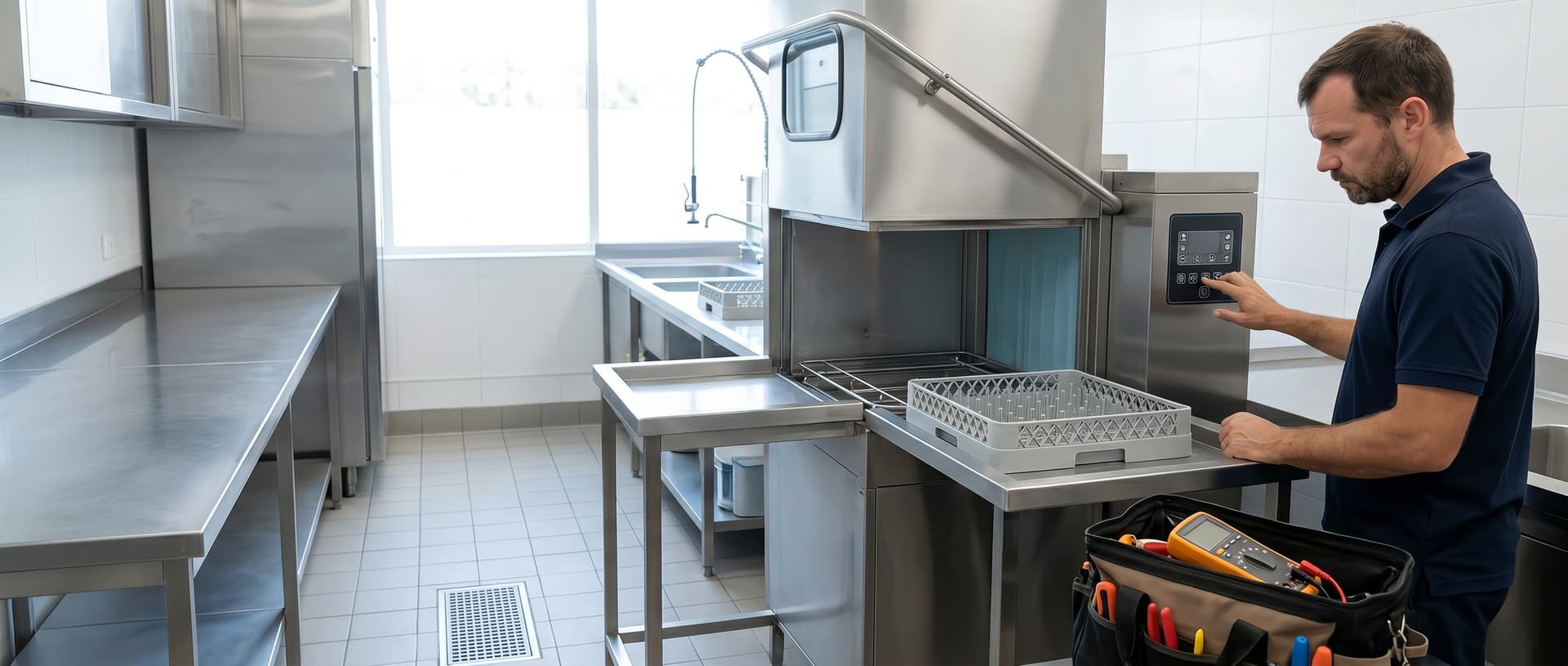
Commercial Kitchen · Dishwasher Not Heating · Booster Element & Sanitization Diagnostic
Commercial Dishwasher Not Heating: Booster Heater & Wash Tank Diagnostic
NSF 180°F final rinse compliance. Booster element, wash tank element, thermostat, scale insulation. Final rinse checked before and after. $120 diagnostic. Same-day across LA, OC, Ventura.
AI Diagnostic · free · about a minute
Dishwasher acting up?
Describe it in your own words — get the likely causes and a repair cost range before you book.
Our Branches
10 service territories across Southern California
01 · Not heating diagnostic
Booster heater failure is a food-safety event, not a routine repair.
A commercial dishwasher that won't reach 180°F final rinse sanitization spec in LA commercial kitchens usually traces to one of three root causes our techs at Same Day Appliance Repair diagnose first across DTLA hotel banquet operations, Beverly Hills hospitality, LAUSD school nutrition cafeteria, hospital cafeteria service, restaurant kitchens 8-14 hr daily, and institutional dining operations running Hobart, Jackson, and Champion high-temp commercial dishwashers. (1) Booster heater element failure year 6-9 — element open circuit means controller can't raise final rinse to 180°F sanitization spec. Health code violation territory if operator continues running below spec. Booster heater element replacement is labor $300–$640 + parts, 60-90 minutes. (2) Booster heater contactor wear year 6-9 — contactor doesn't engage element under control signal. Contactor replacement is labor $300–$640 + parts. (3) LADWP hard water scale buildup on booster heater element — scaled element can't transfer heat efficiently, runs continuously but not reaches setpoint. Descaling service (labor $250–$520) often resolves without element replacement. $120 commercial diagnostic at Same Day Appliance Repair, waived with repair. NSF 180°F final rinse sanitization spec is health code requirement (California Retail Food Code) — operator stops service immediately if booster fails.
"Dishwasher not heating" is the highest-priority commercial dishwasher service call we run. The customer report is usually one of three: dishes coming out lukewarm, the temperature display reading below 180°F on the rinse cycle, or a health inspector flagging final rinse temp during routine inspection.
The food-safety stakes: NSF/ANSI 3 standard requires high-temp commercial dishwashers to deliver 180°F minimum at the dish surface during the final sanitizing rinse. Below 180°F, thermal sanitization is not achieved. Pathogens including E. coli, Salmonella, and Listeria can survive on dishware that looked visually clean. LADPH, OC Health Care Agency, Ventura County Environmental Health, San Bernardino County DEHS, and Riverside County all enforce this requirement during restaurant inspections.
A booster heater failure or wash tank heater failure is therefore not a "schedule it next week" issue. We treat it as a same-day priority commercial dispatch.
$120 commercial diagnostic, waived with repair. BHGS #A49573 and EPA 608 Universal certified (#1346255700410). 90-day warranty. Same-day across LA, OC, Ventura. Sister sub-services: not cleaning, leaking water, error codes. Overview: commercial dishwasher repair.
02 · Booster heater vs wash tank heater
Two separate heaters. Different diagnostic, different repair.
Across LA County commercial dishwasher not-heating service calls our techs at Same Day Appliance Repair dispatch — DTLA hotel banquet 24/7 operations with booster + tank heater dual-system, LAUSD school nutrition FT2000 flight-type fleet with large booster capacity, hospital cafeteria service, restaurant kitchens 8-14 hr daily, plus institutional dining hall operations — the failure distribution clusters predictably. About 30 percent LADWP hard water scale buildup on booster heater element (single most common heating issue in LA, descaling labor $250–$520). 20 percent booster heater element failure (year 6-9, labor $300–$640 + parts). 15 percent booster heater contactor wear (year 6-9, labor $300–$640 + parts). 15 percent wash tank heater element or contactor (year 6-9, labor $300–$640 + parts). 10 percent thermostat drift (year 6-9, labor $300–$640 + parts). 10 percent control board faults on year 10+ units (labor $275–$550 + parts). NSF 180°F final rinse sanitization spec compliance critical — below spec triggers California Retail Food Code CCP exceedance, LADPH inspection violation territory.
Most commercial dishwashers (door-type, undercounter, rack-conveyor, flight-type) carry two distinct heaters. The diagnostic starts with figuring out which one failed.
- Wash tank heater. Maintains wash water at 150 to 160°F for detergent activation and grease cutting. Located in the wash tank itself. Failure symptoms: greasy plates, food residue not breaking down, dishes coming out warm but not hot. Element replacement labor $300–$640 + parts ($375–$750 on Hobart, Jackson, Meiko, Winterhalter).
- Booster heater. Takes incoming hot water supply (typically 140°F at the building) and raises it to 180°F+ for final rinse only. Located inline before the rinse manifold. Failure symptoms: dishes wash fine but final rinse temp drops below NSF spec, sanitization compliance violation. Element replacement labor $300–$640 + parts ($375–$750 on Hobart, Jackson, Meiko, Winterhalter); module replacement when the tank is corroded is quoted after diagnosis.
Diagnostic sequence at the $120 visit:
- Live-cycle temperature test at the manifold with calibrated digital thermocouple. Wash tank reading and final rinse reading captured separately.
- Visual inspection of both elements. Scale insulation, burnout, terminal corrosion.
- Thermostat continuity test. Often the silent fault when element looks healthy.
- Supply pressure and incoming water temperature verification. Sometimes the building supply is the actual root cause.
- Readings. We tell you the before-and-after temperatures.
03 · High-temp vs low-temp sanitizing
Both NSF compliant. Different failure modes.
Commercial dishwashers split into two sanitization architectures. Both are NSF compliant when properly operated; both pass health inspection when functioning correctly.
- High-temp (thermal sanitizing). Final rinse at 180°F+ sanitizes by heat alone. No chemical sanitizer in the rinse. Booster heater is the critical component; failure = compliance violation. Most Hobart, Champion 86, Jackson AJ, Meiko, Insinger pro-tier are high-temp.
- Low-temp (chemical sanitizing). Final rinse at 110 to 140°F plus chlorine-based or quaternary ammonium sanitizer dispensed during rinse. Lower energy cost; relies on chemical concentration for compliance. Some CMA Dishmachines, Champion DH-6000 series, and many Fagor Industrial under-counter / door-type units are low-temp.
When a low-temp unit fails to sanitize, the cause is typically the chemical dispenser, not heating. We test both pumps and titrate sanitizer concentration with a chlorine test strip during the diagnostic. When a high-temp unit fails, the cause is usually the booster heater. Different fix path, same $120 diagnostic.
04 · Top causes of heating failure
In honest frequency order.
1. Booster heater element burnout (year 4-7 typical)
Most common high-temp failure. Resistance wire breaks from thermal cycling and accumulated scale insulation. Symptom: final rinse temp at manifold reads 150 to 170°F instead of 180°F+. Replacement runs labor $300–$640 + parts ($375–$750 on Hobart, Jackson, Meiko, Winterhalter); the element is priced after diagnosis.
2. Scale insulation on element (LA hard water primary)
Mineral deposits on the element surface insulate the heating coil from the water. Element draws full current but transfers less heat. Symptom: temp slowly drifts down over months; element eventually burns out from thermal stress. Descale service runs labor $250–$520 standalone; element plus descale is labor $300–$640, parts quoted after diagnosis.
3. Wash tank heater element burnout (year 5-8 typical)
Same failure mode as booster element but at lower duty cycle so longer lifespan. Element replacement labor $300–$640 + parts; $375–$750 on Hobart, Jackson, Meiko, Winterhalter.
4. Thermostat drift
Thermostat reads incorrectly or fails closed-position. Element runs continuously (overheats) or fails to engage (undertemperature). Replacement labor $300–$640 + parts.
5. Chemical sanitizer dispenser failure (low-temp units)
Peristaltic pump worn, line clogged, container empty, or operator-side dilution mistake. We test sanitizer concentration with chlorine titration strip and verify pump function with line detached. Pump replacement labor $250–$520 + parts.
05 · Pricing
Heating-failure repair costs.
| Repair | Labor (parts quoted after diagnosis) |
|---|---|
| Diagnostic (commercial, includes manifold temp test) | $120, waived with repair |
| Booster heater element replacement (mid-tier) | $300–$640 + parts |
| Booster heater element replacement (pro-tier: Hobart, Meiko) | $375–$750 + parts |
| Wash tank heater element replacement (mid-tier) | $300–$640 + parts |
| Wash tank heater element replacement (pro-tier) | $375–$750 + parts |
| Booster heater module replacement (tank corroded) | $300–$640, parts quoted after diagnosis |
| Thermostat replacement | $300–$640 + parts |
| Mineral scale removal service (standalone) | $250–$520 |
| Chemical sanitizer dispenser pump replacement (low-temp units) | $250–$520 + parts |
| Warranty | 90 days parts plus labor |
06 · Health Department coordination
When the inspector flags final rinse temperature.
When a health inspector flags final rinse temperature during inspection, the operator typically gets a corrective-action timeline (often 24 to 72 hours depending on jurisdiction and severity). We treat these as priority calls, fix the heater, and tell you the before-and-after readings.
- LADPH (LA County). Los Angeles County Department of Public Health. Most restaurants we service.
- OC Health Care Agency. Orange County. Similar process to LADPH.
- Ventura County Environmental Health. Thousand Oaks, Westlake, Camarillo, Ventura.
- San Bernardino County DEHS. Inland Empire. Rancho Cucamonga, Ontario, Fontana.
- Riverside County Environmental Health. Temecula, Murrieta, Riverside.
Every booster heater repair includes before-and-after final rinse temperatures measured at the manifold with a calibrated digital thermocouple. We tell you both readings.
07 · Why operators call us
Seven reasons.
- Same-day priority dispatch on booster heater calls. We treat NSF compliance violations as commercial emergencies.
- Manifold-tested temperature verification. Calibrated digital thermocouple, not rated-spec assumption.
- Before-and-after readings. You hear the final rinse temperature before and after the repair.
- Booster vs wash tank diagnostic discipline. We isolate the right heater before quoting parts.
- Common booster elements stocked. Hobart CRS, Champion 86, Jackson AJ on the van for same-day swap.
- BHGS #A49573 and EPA 608 Universal certified (#1346255700410). See our licensing page.
- $120 commercial diagnostic, no emergency surcharge. Phones answered 24/7.
Cross-link: rack conveyor, flight type, undercounter, glass washer. Credentials: BHGS license, EPA 608.
08 · FAQ
Booster heater and not-heating, common questions.
Why is my commercial dishwasher not heating water?
A commercial dishwasher that won't reach 180°F final rinse sanitization spec usually traces to one of three causes our techs at Same Day Appliance Repair diagnose first across Hobart, Jackson, Champion, and CMA high-temp commercial dishwasher installations. (1) Booster heater element failure year 6-9 — element open circuit means controller can't raise final rinse to 180°F. Health code violation territory if operator continues running below spec. Booster heater element replacement is labor $300–$640 + parts, 60-90 minutes. (2) Booster heater contactor wear year 6-9 — contactor doesn't engage element under control signal. Contactor replacement is labor $300–$640 + parts. (3) LADWP hard water scale buildup on booster heater element — scaled element can't transfer heat efficiently. Descaling service (labor $250–$520) often resolves without element replacement. Plus thermostat drift year 6-9 (labor $300–$640 + parts) and control board faults on year 10+ units (labor $275–$550 + parts). Our techs measure final rinse temperature with certified probe + booster element continuity test + contactor coil voltage check on every not-heating call.
What temperature should a commercial dishwasher reach?
Commercial dishwasher temperature requirements depend on sanitization method. High-temp sanitizing (most commercial installations) requires final rinse 180°F (NSF + California Retail Food Code requirement). Wash tank typically operates 150-160°F. Low-temp chemical sanitizing (some bar glass washers, low-volume undercounter) operates wash tank 120-140°F with chemical sanitizer (50-100 ppm chlorine). Below 180°F final rinse on high-temp machine is California Retail Food Code CCP exceedance triggering LADPH inspection violation territory — operator must stop service immediately and restore to spec or switch to manual sanitization protocol. Our techs at Same Day Appliance Repair carry certified probes on every dishwasher service visit; we check final rinse temperature on every commercial service call and tell you the reading. Common cause of below-spec final rinse: LADWP hard water scale buildup on booster heater element (resolved by descaling, labor $250–$520) or booster heater contactor failure (labor $300–$640 + parts).
Why is the NSF 180°F final rinse temperature requirement food-safety critical?
NSF/ANSI 3 standard requires high-temp commercial dishwashers to deliver 180°F minimum at the dish surface during the final sanitizing rinse, with the booster heater raising water temperature from the typical 140°F supply to the 180°F+ rinse spec. Below 180°F, thermal sanitization is not achieved; pathogens (E. coli, Salmonella, Listeria) can survive on dishware. LADPH, OC Health Care Agency, Ventura County Environmental Health, San Bernardino County, and Riverside County all enforce this in restaurant inspections. A booster heater failure is not a 'fix it later' issue; it is a same-day shutdown risk.
How fast can you respond to a booster heater failure?
Same-day across Los Angeles, Orange, Ventura when a technician is available; call early for the best chance. Inland Bernardino and Riverside next-morning standard. Phones answered 24/7 for booking; we route booster heater calls as priority commercial because of the food-safety implications. We carry common booster heater elements for Hobart CRS, Champion 86, Jackson AJ on the van for same-day swap when stocked.
What's the difference between high-temp and low-temp commercial dishwashers?
High-temp units rely on 180°F+ thermal sanitizing in the final rinse (no chemical sanitizer needed). Low-temp units run cooler rinse (110 to 140°F) plus chemical sanitizer (typically chlorine-based) for sanitizing. Both are NSF compliant when properly operated. High-temp failures show up as booster heater problems; low-temp failures show up as chemical dispenser problems. We service both. Hobart, Champion, Jackson AJ, Meiko premium pro-tier are typically high-temp. Some CMA Dishmachines and Champion DH-6000 series are low-temp.
Booster heater versus wash tank heater. Which is which?
Two separate heaters in most commercial dishwashers. Wash tank heater maintains the wash water at 150 to 160°F for detergent activation and grease cutting. Booster heater takes incoming hot supply (140°F typical) and raises it to 180°F+ at the moment of final rinse. Both can fail; the diagnostic is different. Wash tank cold = greasy plates. Booster heater fault = sanitizing temperature violation. We test both at the manifold during a live cycle.
What do you check after a booster heater repair?
We run a live cycle and measure the final rinse at the manifold with a calibrated digital thermocouple, before and after the repair, and tell you both readings. On a high-temp machine the target is 180°F at the final rinse; on a low-temp machine we check the sanitizer dose instead.
How much does booster heater element replacement cost?
Booster heater element replacement runs labor $300–$640 + parts; on Hobart, Jackson, Meiko, and Winterhalter units labor is $375–$750. The element itself is priced after diagnosis. Element plus full tank descale (when scale insulation is the contributing cause) and complete booster heater module replacement (rare, typically when the tank itself is corroded) are quoted after diagnosis, with parts priced separately. We always test for scale insulation before quoting a full module replacement; descale plus element swap saves real money when applicable.
What's your warranty?
90 days SDAR labor warranty on every repair. BHGS #A49573 and EPA 608 Universal certified (#1346255700410).
Final rinse below 180°F? Call today.
$120 commercial diagnostic. Same-day priority dispatch. Final rinse temperature checked on every call. BHGS #A49573 and EPA 608 Universal certified.